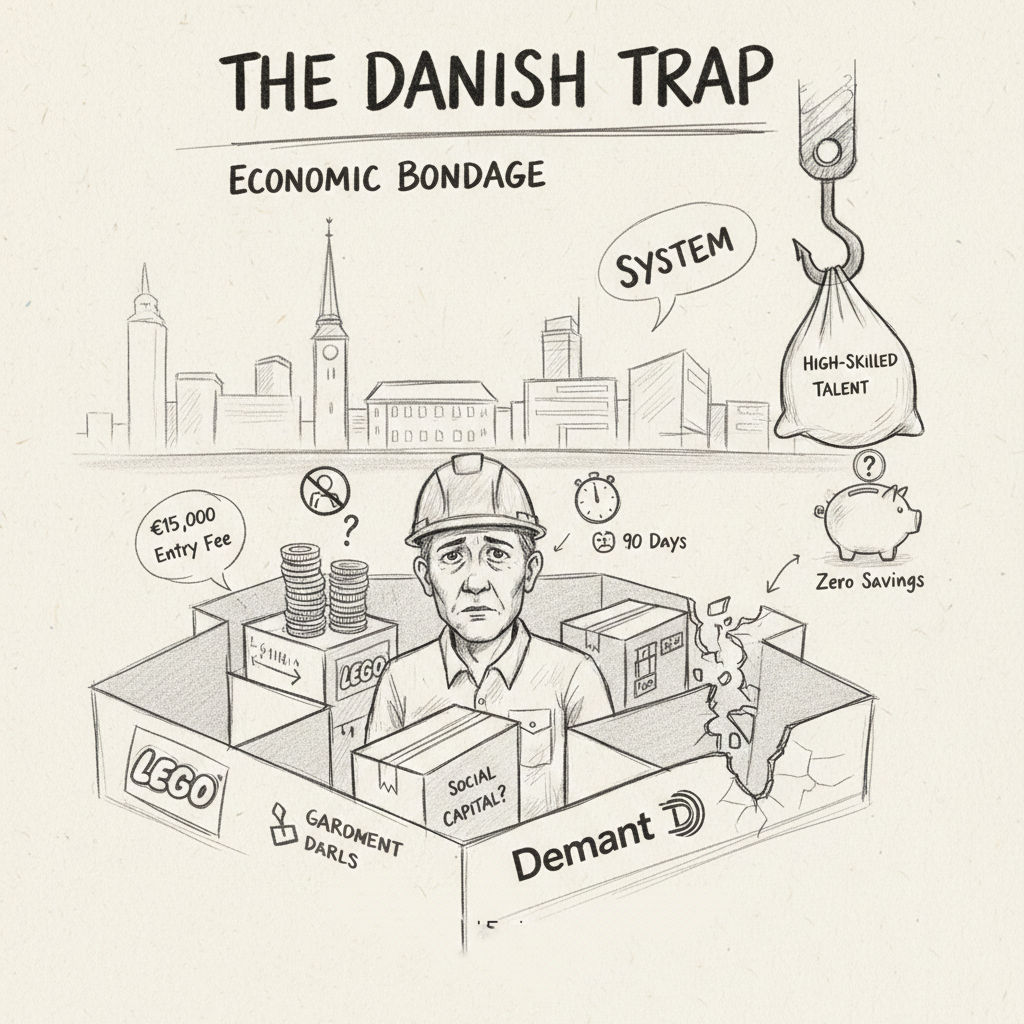
Many see Denmark as a socialist utopia — a land of Lego, Hygge, and the world’s happiest people. But in 2021, I stepped into a different reality. After three years of living in Copenhagen, I can tell you that the “Danish Dream” is a well-oiled machine designed to extract professional talent while giving nothing back in terms of security or social capital.
If you are thinking of moving there in 2026, read this first.
The Long Game and the “Relocation” Scam
My journey began with two years of searching for a job from Germany. Looking back, that should have been my first warning. The Danish market is notoriously closed, but I was stubborn.
I eventually signed with Demant, a corporate giant. They promised a relocation package, but it was a farce. The company paid exorbitant sums to third-party “relocation experts” who did absolutely nothing. I ended up paying for my own flights to Copenhagen for interviews and the final move. When you factor in the costs for two people and a cat, I was down thousands of euros before I even received my first Danish Krone.
The Financial Barrier: €15,000 Just to Enter
Copenhagen’s housing market isn’t just expensive; it’s predatory. To rent a standard one-bedroom flat (approx. 14,000–16,000 DKK), you are forced into a financial corner:
- The 3+1+1 Rule: You pay 3 months’ rent as a deposit, plus the first month, plus the last month in advance.
- The Entry Cost: I had to drop nearly €15,000 just to get the keys.
But the real sting comes when you leave. In Denmark, it is standard practice for landlords to take the final 15 days of your rent to “renovate” the apartment for the next tenant. You pay for their maintenance. In my case, despite leaving the flat in pristine condition, the management company calculated a refund of roughly €100 and then simply vanished. They know you’re leaving the country; they know you won’t sue. It’s legalized theft.
The “Overqualified and Underpaid” Paradox
I am an engineer with years of experience. In any other country, that means a seat at the table. In Denmark, I was treated like a lab assistant.
I was earning 58,000 DKK gross. After the brutal Danish taxes, I was left with 35,000 DKK net. In Copenhagen, where inflation has doubled the price of basics over the last three years, this is “survival money” for a couple.
- The Wage Gap: My Danish colleagues, often with less experience and fewer skills, were easily making 30,000–40,000 DKK more than me. Mean official salary based on Danish statistics is 75,000 DKK for my experience.
- The Wife’s Struggle: My wife spent three years searching for work. The system is designed for dual-income households, but it’s nearly impossible for an expat spouse to break in.
Corporate Culture: A “Gas Chamber” of Incompetence
Working at a big Danish corporation was a psychological nightmare. I found myself surrounded by what I can only call “management by inertia.” A revolving door of managers and “old-school” executives who lacked basic modern competence but held all the power.
As an expat, you have zero Social Capital. You are outside the “tribe.” You are expected to do the heavy lifting for a fraction of the pay, while being told you are “lucky to be here.” When I tried to find another job, the offers were insulting: “We have no budget, would you like to volunteer?” — this to a senior engineer.
The “Debt by Default” System
Denmark is a society of systems, not people. If you miss a bill by one hour, you don’t get a polite reminder. You get a late fee. The entire service economy is built on penalizing the consumer. You are in a constant state of anxiety, feeling like you owe money to a dozen invisible entities. It creates a feeling of being hunted by bureaucracy.
The Final Trap: 0 Days to Disappear
The cruelty of the Danish immigration law is most apparent when you lose your job.
- The day you are fired, you have in the best case 90 days to find a new job or leave.
- Your apartment contract usually requires a 3-month notice to terminate.
It is a perfect trap. You are legally required to leave the country at the exact moment your housing contract expires, leaving you no time to pack, settle your affairs, or fight for your stolen deposit. You are processed like a defective part in a factory and discarded.
Conclusion: A Beautiful Country, A Broken System
I love Denmark. I love the streets of Copenhagen and the people I met. But the Danish state has lost its humanity in its obsession with “the system.”
After three years, I have:
- Zero savings (it all went to rent and cost of living).
- Wasted years of professional growth.
- No legal path to stay.
In 2025, Denmark is not a land of opportunity for outsiders. It is a corporate colony where you are “overqualified and underpaid” by design. If you value your career and your mental health, stay away.