Let’s not forget that we are engineers first.
Sometimes you need to flex your mental muscles and solve unconventional problems—even those that seem pointless, the ones people say are “easier to solve another way” or “cheaper to buy than to fix.” Why? Let me tell you about a situation I ran into recently.
I live in an apartment with a pretty interesting smart lock. But, as usual, companies love their proprietary chargers. If you lose that one specific cable—which is exactly what happened in my place—you’re basically doomed. You can’t charge a lock that costs nearly €400. Fun, right? Not really. It’s made worse by the fact that you only need to charge the thing once every six months. That’s the perfect amount of time for a black braided cable to vanish into thin air forever.
My landlord eventually gave up. He couldn’t find a way to order a new proprietary wire, so he just handed me a physical key and called it a day. But I’m an engineer, aren’t I? Am I really unable to charge a basic lock just because the connector is “special”?
The Raw Data: I had the lock, a weird port, and the knowledge that it definitely runs on a standard 5V USB line.
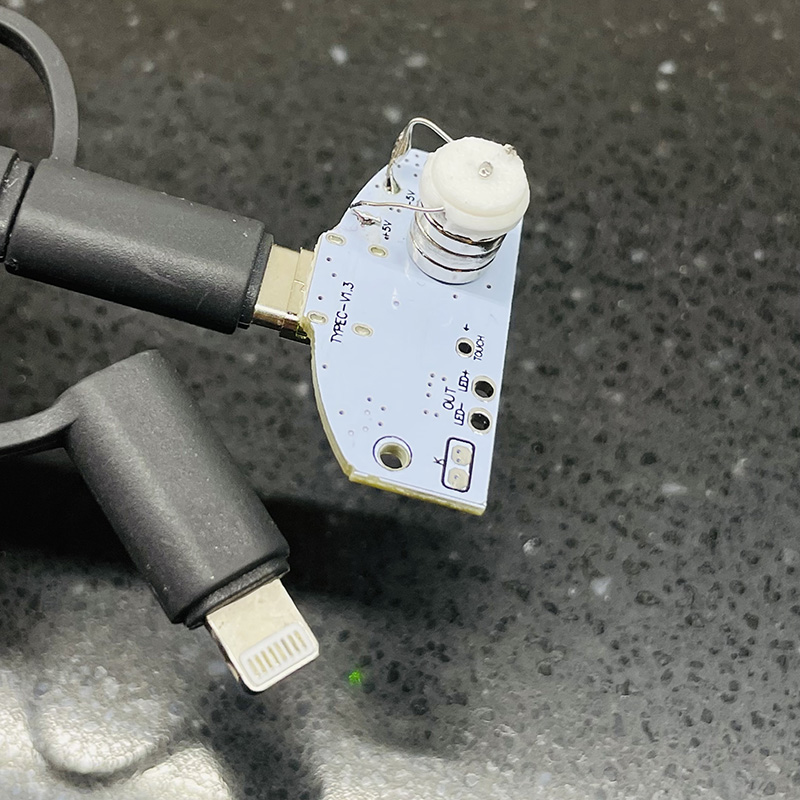
Honestly? That’s all you need. Since I didn’t have a spare USB cable lying around that I wanted to butcher, I found a circuit board from an old USB-C flashlight and soldered directly to the 5V test points. I measured the dimensions of the proprietary port, jumped into CAD, and designed a small plastic adapter. I 3D-printed this little “puck” and glued a magnet to the back so it would snap onto the lock, just like the original.
Now for the main part: I took two tiny wires and positioned the contacts so the plus hits the center point and the minus hits the outer rim. That’s it! You plug it into USB, feed it 5 volts, and the lock starts charging. I call that a win.
But here’s the real question: Why do this? Many would say, “What nonsense,” or “Just buy the damn cable,” or “Let the landlord deal with it.”
Listen carefully: the moment you hear those voices in your head, you stop being an engineer and start being a consumer. A consumer has nothing in common with a creator or an engineer. That mindset is absolute poison for an engineering brain. Drive it away. Focus on doing things “Just for Fun,” as Linus Torvalds says.
That specific feeling—knowing you built a solution out of “shit and sticks” on your kitchen table, a solution you might only need once in your life—is enough. You don’t always need to overcomplicate your life. The path of a successful engineer starts right there: with the first crooked, ugly prototype. If it works, wait until it breaks or starts to annoy you, then fix it. If someone else needs it, give it to them. If people start asking “Where can I get one?”, build a few more and make them better. That path can lead to thousands or millions of units.
Don’t be afraid to be an engineer. Go for it.